
While predictive analytics is nothing new, many organizations still struggle to get a workable predictive analytics solution off the ground.
This isn’t just a private sector challenge, either. It goes all the way up to the federal government, as federal agencies are now challenged with developing predictive analytics solutions for preventing billions of dollars in waste that happens every year. (Read: The Government’s Predictive Analytics Gap That’s Costing Billions.)
The Predictive Analytics Puzzle for Organizations
The problem with predictive analytics is not rooted in lack of technology or high costs. Indeed, the entry cost for building a predictive analytics solution has never been lower. Cloud-based machine learning platforms have dramatically lowered the infrastructure barrier, and explainable AI (XAI) frameworks have addressed the “black box” concern that kept risk-averse organizations on the sidelines.
The simple fact is that predictive analytics is now a design challenge: most organizations simply don’t know where to start.
What Is Predictive Analytics?
Predictive analytics is a data-driven approach that uses statistical techniques, machine learning, and algorithms to analyze historical data and make informed predictions about future outcomes.
By identifying patterns and trends within large datasets, predictive analytics helps organizations anticipate events, optimize decision-making, and proactively address challenges. It has endless practical applications, from forecasting consumer behavior in business to improving resource allocation in government.
The 5 Layers of A Successful Predictive Analytics Solution
A successful predictive analytics solution is built on 5 essential layers. These aren’t sequential steps; they’re interdependent building blocks. If even one layer is weak, it will limit what’s achievable within the entire system.
- Data Trust: Your predictive analytics solution is only as reliable as the data it’s trained on. Before investing in modeling, you need to establish data quality standards, resolve inconsistencies, and build consistent taxonomies across systems.
- Integrated Architecture: Models trained on siloed data can only predict within that silo’s reality. Cross-system integration gives predictive analytics its power.
- Fit-for-Purpose Modeling: The right predictive analytics model is not necessarily the most sophisticated one; it is the one that reliably answers the right questions for your organization. Some of the most impactful predictive programs run on straightforward regression analyses applied to well-structured historical data.
- Human-in-the-Loop Design: The role of predictive models is to recommend so that people can intelligently decide. Explainable AI (XAI) frameworks, which require models to surface their reasoning, are becoming the standard in predictive analytics for this exact reason.
- Governance & Accountability: A predictive model without governance is a liability. Model versioning, bias testing, fairness audits, and documentation of how predictions inform decisions should all be baked into your program.
Start With a Simple, Singular Focus
The most common mistake organizations make with implementing a predictive analytics solution is trying to do too much at once. A multi-year enterprise transformation is not the right starting point. A single, well-chosen prediction problem is.
 Figure 1: Crawl → Walk → Run: Start small, prove value, then scale
Crawl: Audit Your Data
Before building any predictive analytics solution, understand what you have. Where does your data live? How clean is it? How complete? A data maturity assessment, even an informal one, is the non-negotiable first step. It shapes every decision that follows.
Walk: Pick One High-Value Problem
Not the hardest problem. The one where the data is cleanest, the outcome is clearest, and a stakeholder is ready to champion the result internally. Build something that works, demonstrate the value, and create organizational momentum.
Run: Expand Deliberately
Once you’ve proven the model and built internal confidence, extend your data sources, increase model sophistication, and integrate predictions into operational workflows, not just standalone reports. Scale what works.
Match Your Model Complexity to The Problem’s Complexity
One of the other most common missteps is over-engineering your predictive analytics solution. Not every problem requires deep learning. The right model is the simplest one that answers your question reliably.
For well-structured problems with clean historical data, linear regression predicts a continuous outcome (cost overruns, staffing needs, equipment wear rates) with minimal overhead. Logistic regression handles binary classification cleanly: fraud or not, high-risk or low-risk, compliant or non-compliant. Decision trees add interpretability for rule-based decisions, making them a natural fit for eligibility determinations or inspection prioritization where auditability matters.
As problem complexity grows, so does the appropriate toolset. Time series models like ARIMA or Prophet surface seasonal patterns and trends in workforce demand, procurement cycles, or infrastructure load. Ensemble methods such as random forests and gradient boosting handle messier, higher-dimensional data where single models break down. Neural networks and graph analytics enter the picture only when the data is unstructured or the patterns span complex relational networks, such as detecting fraud rings or anomalies across agency-wide transaction graphs.
The discipline is in the matching. Organizations that start with the simplest model for their problem tend to build faster, explain results more easily, and earn organizational trust sooner. Complexity is a tool, not a goal.
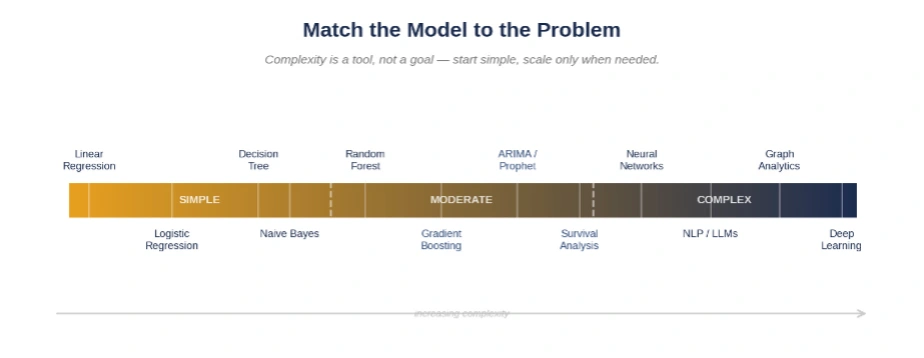 Figure 2: Model complexity spectrum, match the approach to the problem
The organizations making real progress aren’t the ones with the largest AI budgets. They’re the ones that started with the right question, built a foundation that held, and earned the trust to grow.
Find an Experienced Predictive Analytics Partner
Organizations that close the predictive analytics gap don’t start with a perfect data strategy. They start with the right first problem, but they also choose the right partner to bring outside clarity to the project and manage the more complex, technical challenges of building an effective predictive analytics solution.
VersaTech brings nearly two decades of experience helping federal, state, and local agencies, institutions, and organizations build the data foundations, integration architecture, and analytics capabilities that make prediction possible, at the program level and at enterprise scale.
If your organization is ready to move from reactive to predictive, or just beginning to assess where you stand, we’d like to help you find your starting point. Schedule a conversation with VersaTech now.
Sources & References
- Precisely. (2025). 2025 Data Integrity and Intelligence Report.
- U.S. GAO. (2025). Fiscal Year 2024 Federal Improper Payments and Fraud Risk Data.
- Federal AI Use Case Inventory, OMB. (2024). AI use case growth: 710 to 1,757 programs in one year.
- Boston Consulting Group. (2024). Closing the AI Value Gap: Only 26% of initiatives realized meaningful value.
- HRSA National Center for Health Workforce Analysis. (2024). National and State-Level Projections of Supply and Demand for Primary Care Practitioners: 2021–2036.
- Federal Highway Administration. (2024). Bridge Condition and Performance: National Bridge Inspection Standards and Predictive Asset Management.
- U.S. Customs and Border Protection. (2024). Automated Targeting System (ATS): Risk-Based Targeting Overview.
- Air Force Life Cycle Management Center. (2024). Condition-Based Maintenance Plus (CBM+): Advancing Predictive Maintenance Across Air Force Platforms.
- Office of Management and Budget. (2025). Memos M-25-21 and M-25-22: Federal Government Use of Artificial Intelligence.