
Whether you’re planning a cloud migration, mid-migration, or modernizing an environment that moved to cloud years ago without AI in mind, stop what you’re doing and ask yourself: are we prepared for what’s next in AI?
If your organization is like most, the answer is probably no. But that doesn’t mean the pressure isn’t on—and coming at you from all angles. Leadership teams want AI capabilities yesterday. Compliance teams want an audit trail that holds up under scrutiny. Most infrastructures were designed for web apps and batch jobs, not inference pipelines and retrieval-augmented generation (RAG), and saddled with legacy ERP and HR systems that aren’t going anywhere this budget cycle.
63% of Organizations Aren’t Prepared for AI
If you’re left feeling unprepared and overwhelmed, you’re not alone. Gartner predicts that through 2026, organizations will abandon 60% of AI projects that aren’t supported by AI-ready data and infrastructure. In fact, 63% of enterprises don’t yet have, or aren’t sure they have, the right foundation in place. That’s not a model problem. It’s an infrastructure problem.
6 Decisions That Will Make Your Cloud AI-Ready
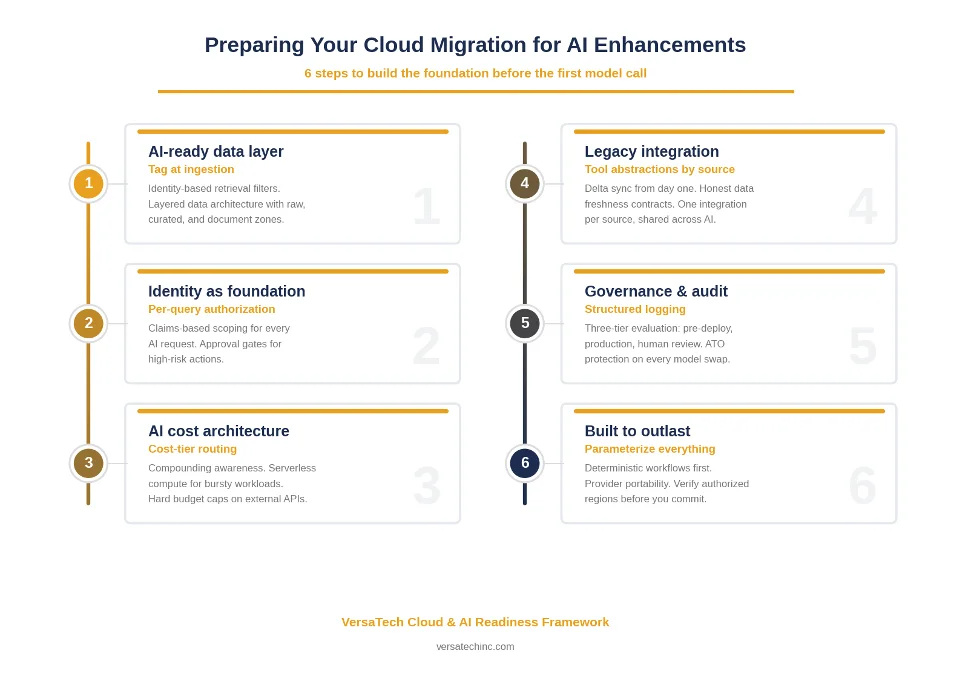
Preparing your cloud for AI isn’t a rip-and-replace. It’s a set of 6 architectural decisions you can start making now, ones that make AI adoption faster and keep your security posture intact. No matter where you are on your cloud migration journey, these 6 decisions will determine whether AI adoption is a smooth configuration exercise or a painful, expensive rebuild.
1. What Does Our AI-Ready Data Layer Look Like?
How much of your data can an AI model actually touch? In regulated environments, that question gets complicated fast.
Build your data architecture in three layers: a raw, immutable ingestion layer for audit and replay; a schema-enforced curated layer for analytics and AI pipelines; and a document layer for unstructured content like SOPs and policies that feeds your RAG knowledge bases. The detail most teams skip is tagging data at ingestion, not retrieval — every document should carry department, sensitivity, and access group metadata enforced at the storage layer. Retrofitting access controls and residency boundaries after migration is painful and expensive; standing up the right foundation during migration costs a fraction of fixing it later.
2. Have We Prioritized Our Identity Layer?
In Zero Trust environments, your identity layer is the foundation everything else inherits from — data scoping, tool permissions, audit trails. Federate your identity provider into your cloud IAM layer, pass claims through your API gateway, and let those claims drive which data sources the AI can query, what actions it can take, and which operations require human approval. If identity federation is a Phase 2 item in your migration plan, move it to Phase 1: every service you migrate without claim-based access is a service you’ll retrofit later at far greater cost.
3. How Will We Manage AI Costs Without Killing Our Budget?
AI query costs are highly variable — model tier, conversation length, tools invoked — and the compute and networking decisions made during migration directly constrain your options later. The architectural response is cost-tier routing: classify queries by complexity and route to the cheapest model that handles them, using rules-based logic rather than another AI call. Use serverless compute to absorb bursty AI traffic without paying for idle capacity, set hard budget caps on external API calls, and account for conversational context compounding — a twenty-turn session can consume more inference budget than fifty one-shot lookups, something you won’t see in a PoC but will find on an invoice at scale.
4. How Will We Integrate AI with Legacy Systems That Aren’t Going Anywhere?
Any AI strategy that assumes greenfield is a strategy that never ships — budget integration time alongside your migration timeline, because the work of connecting legacy systems never makes the first slide deck but always determines whether AI actually ships. Build tool abstractions grouped by data source rather than AI capability so that when a vendor updates their API, you fix one integration, not a dozen. Establish delta sync from day one using incremental queries, webhook-driven updates, and change-data-capture, and define data freshness honestly upfront: “Financial data reflects yesterday’s close” is always better than a wrong number presented as current.
5. How Will We Build AI Governance That Survives an Audit?
Stand up your logging infrastructure as part of migration, not as a separate AI initiative — if observability is a “later” item, you’ll end up building it under pressure after an incident with a review deadline looming. Every AI interaction should produce a structured log covering who asked, what was accessed, which tools were invoked, and what was returned; without it, your ATO package has a gap and your continuous monitoring is guesswork. For AI services calling external APIs, add circuit breakers and rate limiters, alert at 80% of budget, and hard-stop at 100%.
6. Are These Architecture Decisions Built to Outlast the Current Contract Cycle?
Ask yourself: if the contract vehicle changes in three years, can your AI platform survive the transition? The infrastructure decisions made during migration are the hardest to change once everything has landed. Five years from now, the organizations getting the most value from AI won’t be the ones that adopted it first — they’ll be the ones that built a foundation where AI capabilities could be added, swapped, and scaled without reopening their security posture every time. That kind of foundation doesn’t happen by accident. It happens by making the right infrastructure decisions early and deliberately.
Build that foundation right, and your teams work smarter, faster, and with the confidence that the infrastructure behind them can keep up.
Talk to Our Cloud & AI Experts
VersaTech has spent nearly two decades building technology infrastructure for organizations where getting it wrong is not an option. We are ISO 9001, 20000, and 27001 certified with CMMIDEV/3 maturity, and our work spans federal agencies including the Department of Defense, HHS, DHS, the FDA, and DISA, as well as state and commercial organizations.
Our AI and cloud team brings that same rigor to every cloud migration and AI readiness engagement. Whether you are mid-migration, planning your first AI use case, or untangling a cloud environment that was never designed for what you need it to do today, we know how to move you forward without compromising the security posture your mission demands.
Contact VersaTech to schedule a conversation. We’ll help you identify where your cloud foundation stands today, what needs to change before AI can scale, and the most practical path to get there.