
Every major federal agency is sitting on decades of data. Most of it has never been used to predict anything. That is not a technology problem. It is not a budget problem. It is a design problem, and it is finally being solved.
Every major federal agency is sitting on decades of data, much of which has never been leveraged for predictive analytics in government. This is not a technology problem. It is not a budget problem. It is a design problem that needs to be solved.
The case for predictive analytics is visible across virtually every other sector. Hospitals predict sepsis onset hours before symptoms appear, transportation agencies catch equipment failures before fleets are grounded, and financial institutions flag fraud before a transaction clears. In each case, the capability is the same: data is being collected, models are trained to look forward instead of back, and the infrastructure to act on the output is in place.
In federal government, the stakes are especially critical. In fiscal year 2024, agencies reported $162 billion in improper payments, nearly all of it identified after the money had already moved. The data existed. The predictive infrastructure to act on it did not. That gap is what agencies need to solve for, now more than ever.
If the Benefits of Predictive Analytics Are So Clear, What Has Held So Many Organizations Back?
The barriers aren’t excuses. They’re structural, and three of them appear almost everywhere.
First, a 2025 survey found that 67% of organizations don’t fully trust their own data for decision-making, and data governance cited as a barrier nearly doubled in a single year. Predictive models are only as reliable as the data they’re trained on, and this is where most efforts stall before a single model is built.
Second, the infrastructure federal agencies constructed over decades was optimized for accountability, not foresight. Every governance process rewards explaining the past; the data systems followed the same logic.
Third, only 28% of federal applications are currently connected to other systems, which means models trained on siloed data can only predict within that silo’s slice of reality. Beyond the technical gap, acting on a probability rather than a confirmed fact requires a cultural shift that is ultimately a leadership challenge as much as a technology one.
What Does Predictive Data Analytics Actually Mean?
Part of why predictive analytics conversations tend to produce more confusion than progress is the looseness of the term itself. Predictive analytics sits within a broader spectrum of analytical capability, and most organizations are still working to master the earlier stages.
Most frameworks describe four stages of analytics maturity. Descriptive analytics tells you what happened: dashboards, reports, historical summaries. Diagnostic analytics tells you why it happened, drilling into root causes. Predictive analytics tells you what will happen, using models trained on historical patterns to forecast future events. And prescriptive analytics recommends what you should do about it. Each stage builds on the one before it. Skipping stages doesn’t accelerate progress; it creates the conditions for failure.
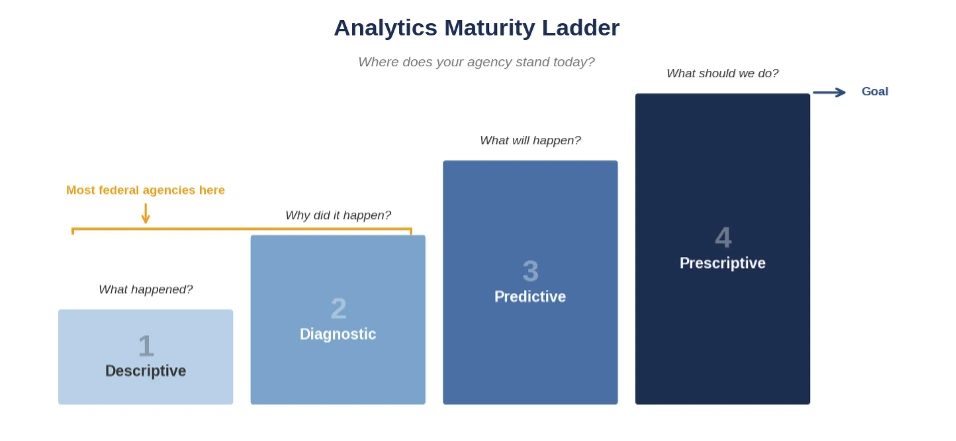 Figure 1: The Analytics Maturity Ladder, most federal agencies are still at stages 1–2
AI is Changing the Equation
Federal AI use cases grew 148% between 2023 and 2024, reaching 1,757 documented programs across government. But only 26% of those initiatives realized meaningful value. The gap is almost always a foundation problem: agencies that jump to predictive or prescriptive modeling without first addressing data quality, integration, and governance produce models that can’t be trusted and outputs that don’t get used.
This is also where AI changes the equation. Cloud-based machine learning platforms have dramatically lowered the infrastructure barrier. Explainable AI frameworks have addressed the “black box” concern that kept risk-averse organizations on the sidelines. The entry cost to start building predictive capability has never been lower, but the foundational requirements haven’t changed. Data quality, system integration, and governance still have to come first.
Predictive Analytics Is Already Working For the Government: 3 Examples
Predictive analytics is delivering results across federal missions, from financial integrity and public health oversight to defense readiness. What these cases share isn’t a large budget or a sophisticated AI platform. It’s a well-defined prediction problem, data that was already being collected, and the discipline to act on the model’s output.
Financial Integrity: IRS Return Review Program
The Internal Revenue Service processes hundreds of millions of tax returns each year. Its Return Review Program (RRP) uses machine learning to score each return for fraud risk in real time, analyzing return characteristics, filing behavior, preparer patterns, and identity indicators, all before any refund is issued. Returns that exceed a risk threshold are held for human review. The IRS reports preventing billions in fraudulent refunds annually through these predictive screening systems. The RRP operates at a volume that no manual review process could replicate, and its models are continuously updated as fraud patterns evolve.
Public Health Safety: FDA Risk-Based Inspection Model
The FDA’s inspection program covers thousands of food and drug manufacturing facilities across the country. Rather than scheduling inspections by calendar rotation, the FDA now uses an AI system that analyzes adverse event reports, historical inspection outcomes, compliance violation patterns, and unresolved corrective actions to predict which facilities pose the highest current risk. The result: the FDA conducted 1,540 more inspections in FY2025 than in FY2024 with no increase in inspector headcount. Predictive targeting didn’t just improve efficiency. It changed what oversight means: resources flow toward risk, not toward schedule.
Defense Readiness: Air Force Condition-Based Maintenance Plus
The U.S. Air Force operates more than 5,500 aircraft, each requiring continuous maintenance to remain mission-capable. Its Condition-Based Maintenance Plus (CBM+) program uses machine learning to analyze sensor telemetry, flight hours, operational load data, and maintenance history to predict which components are likely to fail before the next scheduled service interval. Rather than replacing parts on a fixed calendar, technicians are dispatched based on predicted need. The Air Force Life Cycle Management Center has reported measurable improvements in mission-capable rates and reductions in unscheduled maintenance events across multiple platforms, a shift from time-based maintenance to condition-based maintenance that does the right work at the right time.
What Are the Five Building Blocks of a Predictive Analytics Program?
Across the organizations making real progress, the same five building blocks appear consistently. These aren’t sequential steps; they’re interdependent layers. Data is the bottom layer and the most critical. Weakness in any one layer limits what the others can achieve.
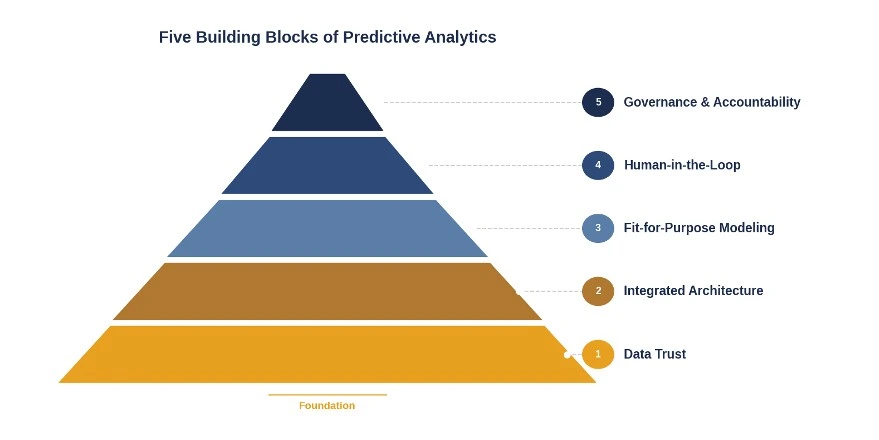 Figure 2: Five Building Blocks, Data Trust is the foundation everything else rests on
- Data Trust Predictive models are only as reliable as the data they’re trained on. Before investing in modeling, organizations need to establish data quality standards, resolve inconsistencies, and build consistent taxonomies across systems. You cannot predict your way out of bad data. This is the foundation everything else rests on.
- Integrated Architecture Silos are the enemy of prediction. A model that can only see one system’s data can only predict one system’s slice of reality. Cross-system integration, built in compliance with the privacy and security frameworks governing federal data, is what gives predictive analytics its power.
- Fit-for-Purpose Modeling The right model is the one that answers your question reliably, not the most sophisticated one available. Some of the most impactful predictive programs in government run on straightforward regression analyses applied to well-structured historical data. The goal is a model accurate enough to be actionable and explainable enough to be trusted by the people whose decisions it informs.
- Human-in-the-Loop Design Predictive models recommend; people decide. In government, where decisions affect citizens’ rights, benefits, and resources, the human review layer is what makes the model defensible and the outcome fair. Explainable AI (XAI) frameworks, which require models to surface their reasoning, are increasingly the standard for exactly this reason.
- Governance & Accountability A predictive model with no audit trail is a liability. Strong governance includes model versioning, bias testing, fairness audits, and documentation of how predictions inform decisions. OMB’s 2025 AI guidance (M-25-21 and M-25-22) makes this a compliance requirement, not just a best practice.
How Do You Start Building a Predictive Analytics Program?
Now that you know the what and the why, the next questions are just as important: how do you build a predictive analytics program and where do you start? For that, be sure to check out our helpful articles, Building a Common-Sense Predictive Analytics Solution That Works. In that article, you’ll get a practical framework for getting started: how to audit your data, how to choose your first prediction problem, how to match model complexity to problem complexity, and how to scale what works.
For one-on-one guidance on predictive analytics in government, contact VersaTech today. Our experts are here to help you build practical predictive analytics solutions that let your teams make smarter, data-driven decisions with total confidence.
Sources & References
- Precisely. (2025). 2025 Data Integrity and Intelligence Report.U.S. GAO. (2025). Fiscal Year 2024 Federal Improper Payments and Fraud Risk Data.
- Federal AI Use Case Inventory, OMB. (2024). AI use case growth: 710 to 1,757 programs in one year.
- Boston Consulting Group. (2024). Closing the AI Value Gap: Only 26% of initiatives realized meaningful value.
- Internal Revenue Service. (2024). IRS Return Review Program: Fraud Detection and Refund Integrity.
- Reed Smith LLP. (2025). FDA Inspections in 2025: Heightened Rigor, Data-Driven Targeting, and Increased Surveillance.
- Air Force Life Cycle Management Center. (2024). Condition-Based Maintenance Plus (CBM+): Advancing Predictive Maintenance Across Air Force Platforms.
- Salesforce. (2024). Connectivity Benchmark Report: 28% of federal applications connected to other systems.
- Office of Management and Budget. (2025). Memos M-25-21 and M-25-22: Federal Government Use of Artificial Intelligence.